SMPTE Motion Imaging Journal · October 2026 · Vol. 135, No. 6
Optimizing 180° Stereoscopic Cinematography for the Apple Vision Pro
Presented by Stanley Lin and Jordan Halsey at the SMPTE 2025 Media & Technology Summit.
The Apple Vision Pro shows more detail than any headset before it, so every flaw in immersive footage shows too. This paper sets out a repeatable, end-to-end pipeline for shooting 180° stereo film that holds up on it, using prosumer gear instead of a high-end immersive camera. The case study is the studio's VR short A Larger Living Space.
- Capture. Canon R5 C with the RF 5.2 mm dual-fisheye lens at 8K, 59.94p, 12-bit Cinema RAW Light in Canon Log 3. 60p keeps motion smooth and reduces discomfort in the headset.
- Exposure and lens. Shooting one stop over (f/5.6, exposed for f/8) cuts shadow noise. f/5.6 was the best trade between sharpness and light: f/2.8 was too soft, and f/7.1 was sharpest but too dark.
- Lighting a 190° frame. The set was built without a ceiling and lit from the grid, with a CG ceiling added in post, and LEDs hidden in practicals. Light guides the viewer's eye without taking away their freedom to look around.
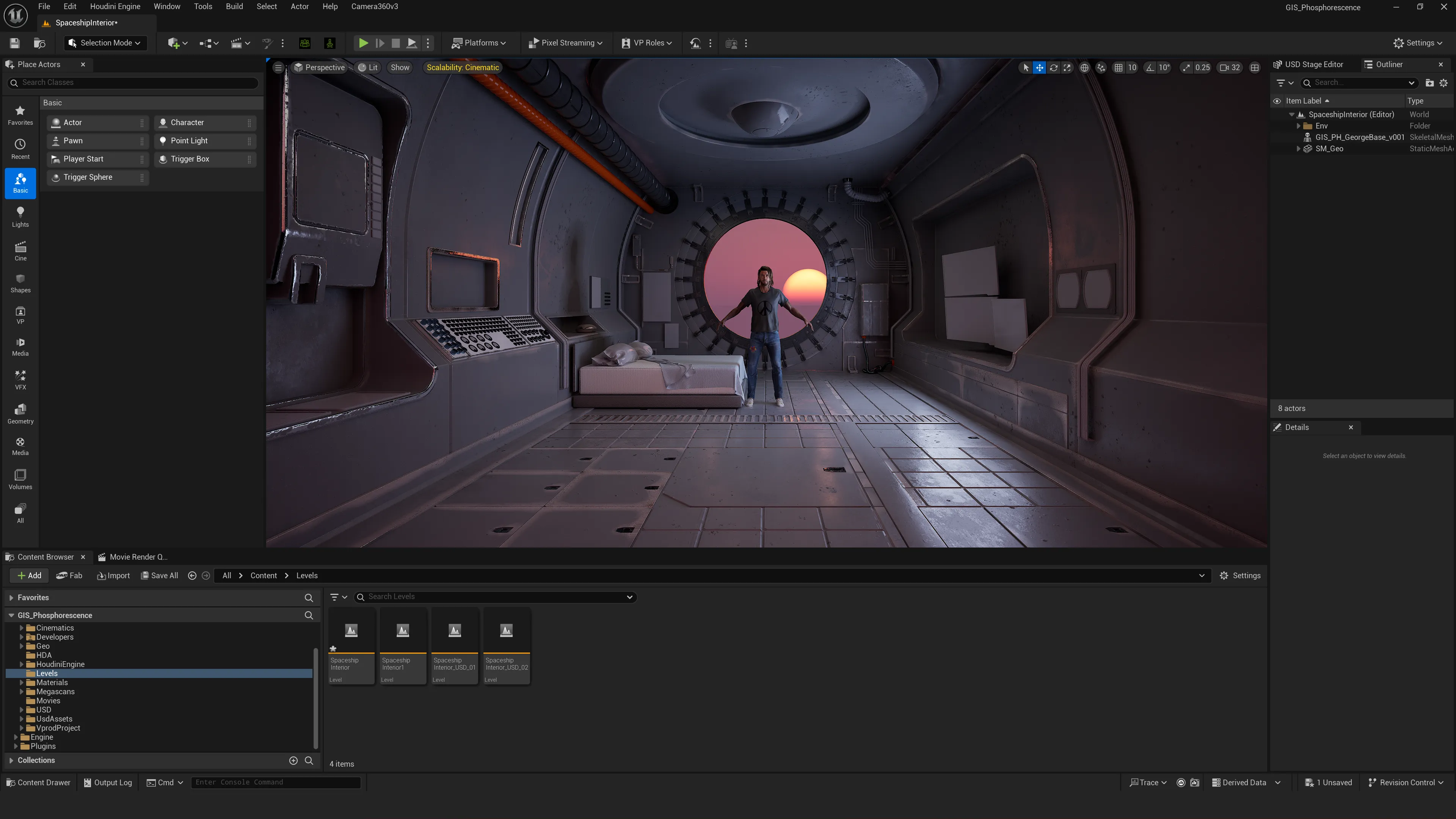
- VFX. The lens was profiled with 3DEqualizer, photogrammetry and a Leica Disto survey; set extensions were built in Houdini with USD, Solaris, Karma and MaterialX, and composited in Nuke.
- Finishing and delivery. AI denoising and a 16K upscale keep fine detail that traditional denoisers smear, before delivery as MV-HEVC with spatial metadata.